
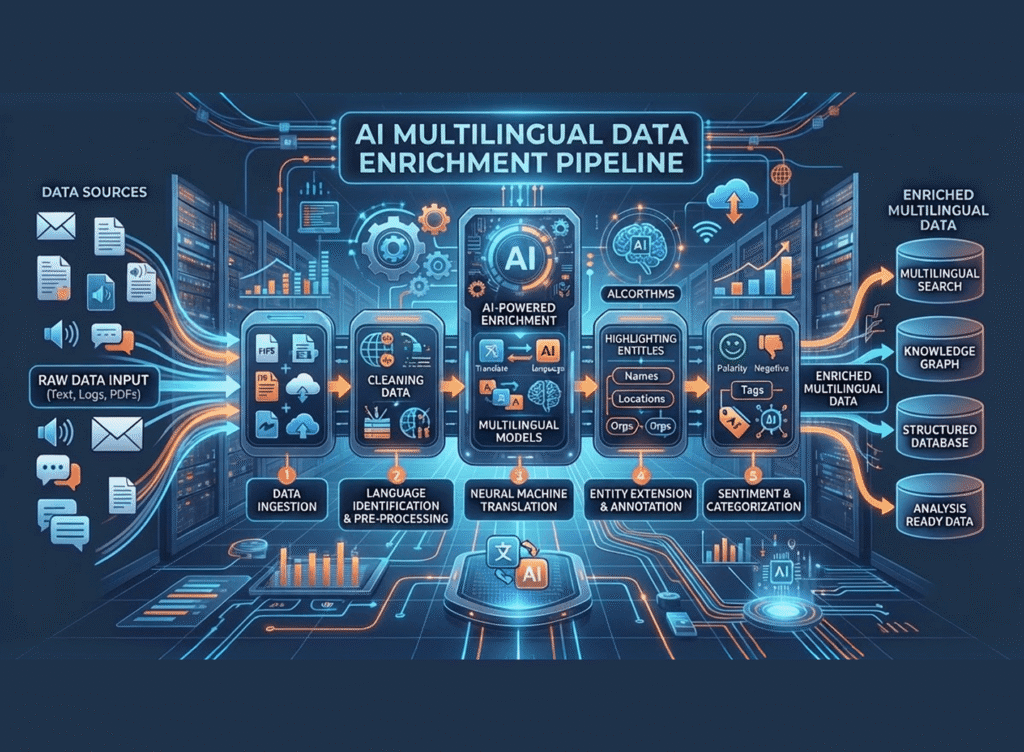


Dun & Bradstreet required a scalable approach to improve the accuracy, consistency, and usability of approximately 25 million business records spanning multiple geographies and languages, including Arabic, English, and French. Netpace developed an AI-powered multilingual data processing pipeline that combined language detection, data cleaning, LLM-based parsing, normalization, validation, translation, and enrichment. The solution transformed large volumes of inconsistent multilingual records into standardized, enriched business data suitable for downstream enterprise use.
Processing approximately 25 million multilingual business records created significant data quality and standardization challenges. Records contained inconsistent formats, noisy or incomplete information, language variations, and attributes that required normalization across different markets. Performing this work manually at scale would require substantial effort and cost while making it difficult to maintain consistent data quality across geographies.
Netpace designed a scalable Python-based pipeline for multilingual data processing and enrichment. The workflow detected languages and pre-cleaned records before using evaluated LLMs and optimized prompt templates to extract and normalize structured information. Data was standardized, deduplicated, validated using automated checks and confidence scoring, translated where required, and enriched with contextual business attributes. The pipeline supported phased geographic processing and incorporated multiple AI models, including Gemini and OpenAI, to evaluate accuracy, reliability, and processing economics.
Improved the accuracy, consistency, and usability of 25M+ multilingual business records by automating data cleaning, standardization, validation, translation, and enrichment, significantly reducing manual processing while creating a scalable, enterprise-ready data pipeline for global datasets.
